

|
|
|
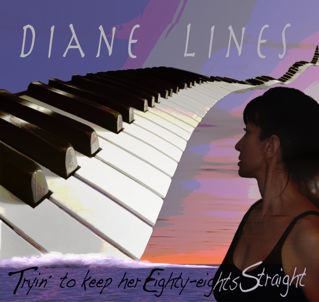 Vancouver
pianist and singer Diane Lines, who I had the pleasure of listening to in
concert and meeting a few years ago at my friend Cory Weeds’ The Cellar
Restaurant / Jazz Club on West Broadway, in Vancouver, is a stellar concert
pianist and she brings that same quality to the second song on her new album
Tryin’ to Keep Her Eight-eights.
Vancouver
pianist and singer Diane Lines, who I had the pleasure of listening to in
concert and meeting a few years ago at my friend Cory Weeds’ The Cellar
Restaurant / Jazz Club on West Broadway, in Vancouver, is a stellar concert
pianist and she brings that same quality to the second song on her new album
Tryin’ to Keep Her Eight-eights.
Although this book of songs opens with the lively, yet
elegant Cole Porter tune “You’d Be So Nice To Come Home To,” it is the title
track, which showcases Diane Lines’ abilities as a pianist and bandleader.
Without question the best song on the album is Jane Vassey’s “Tryin’ to Keep Her
Eighty-Eight Straights,” a song she wrote while playing piano for the Downchild
Blues Band. The horns of Hasselbach
and tenor saxophonist Bill Abbott are fabulous, Rob Ferguson is stellar on drums
and percussion, yet make no mistake about it, Diane Lines is the reason why this
song succeeds, as her piano playing is spectacular and she does a good job on
the vocals. Adrian Armstrong, Tim Porter, Bill Abbott, Tim Stacey and Rob
Ferguson, create a vintage call and response. Whether you are alone or with
someone else, you should be dancing by the time this song is a few bars old. I
know I was!
The strength of the album Tryin’ to Keep Her Eight-eights, by Diane Lines, lays in her skills as an emotive pianist. We also liked the fact that Lines chose several pieces which are not as commonly played by jazz artists today, including a juiced up version of the Jimmy McHugh / Clarence Gaskill song “I Can’t Believe You’re In Love With Me,” made popular by iconic jazz singers such as Billie Holiday and Anita O’Day. Not having heard the Holiday rendition of the song, our only reference point is O’Day and while we are not in even the most remote sense suggesting that Diane Lines is the same league as O’Day as a vocalist, in our humble opinion she out performs O’Day on this tune.
At the mid-point of this album is “Seventh Son,” a hit song for Johnny Rivers, originally written by blues upright bassist and guitarist Willie Dixon, and although Stacey, guitarist Tim Porter and Lines on piano keep this song hopping, it lacks Rivers’ ability to excite. In contrast, on the next track, the Rodgers and Hart song “He Was Good To Me,” you can hear in Diane Lines’ phrasing that she is in the moment and she evokes a stronger response from the listener. Hasselbach serves up a beautiful trumpet solo.
The album closes with the Henry Cosby / Clarence Paul / Vicki Basemore song “Some Other Time,” a reflective lyric that chooses to look forward to another meeting with that special lover or friend, rather than looking at what did not transpire. Upright bassist Tim Stacey accompanies Lines tenderly, while Gabriel Mark Hasselbach’s flugelhorn is gentle.