
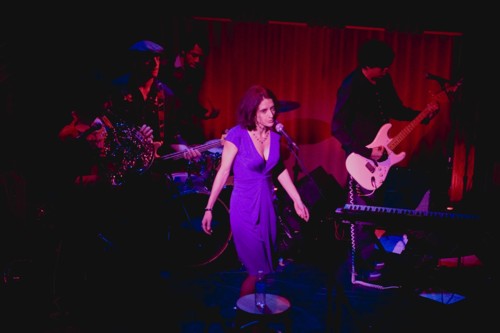
 On
March 3rd, Joe’s Pub, located in
On
March 3rd, Joe’s Pub, located in
“It was a wonderful night and we really filled the place
out. All kinds of people, both whom I knew and whom I didn’t know, came out.
People who were on the record and a smattering of other people who have been
playing with me recently, were all on stage, at different intervals. The setting
(of Joe’s Pub) is so great, because you can put on a real show. I enjoy playing
smaller venues, but Joe’s Pub is the perfect size. We caught a wave and you
don’t always know if you are going to,” says Jost, in recalling the night of her
CD release.
Although it is still early, some songs are emerging as
early fan favorites. “A lot of people like the intro to “Jump,” when I use a
made up language. People relate (well) to the cello and the voice combination
(in “Jump”). “Awake In My Dream,”
comes out for a lot of people, and I don’t know why exactly. People also like
the Iris Dement cover (“Our Town”). The original version of “Our Town,” is
longer, but I edited it down a lot. Our version is totally different, but people
enjoy the way that we have done it. A lot of people enjoy “Halfway There,”
because it is catchy, and it is a real pop song. “Stowaway,” seems to be
something that people relate to on an emotional level,” says Jost.
Serena Jost is a very accomplished storyteller whose
lyrics do not leave the listener grappling with vague metaphors or symbolism,
but instead are easy to follow, and more importantly easy to relate to. However,
Jost’s music is not totally dependent on her skills as a lyricist, far from it.
She is a wonderfully creative composer. Although Jost’s music is closer to an
alternative folk rock style than anything else, there is no mistaking the fact
that she often borrows from her classical training as a cellist, as she did with
the song, “Awake In My Dream.”
The song “Jump,” is introduced
by
The song, “Jump,” also features Jost playing the keys
and guitarist Julian Maile lets loose with some incredible riffs that sure sound
pretty edgy and rock driven, for a guy wielding a classical guitar.
“He (Maile) is an incredible guitarist and one of the
things that I like about Julian is he will never rest on his laurels, or do the
same thing twice. He goes for it full on, and sometimes he just rams it up
against the wall. More often than not, the risk totally pays off. That’s one of
the things that I really love about him. We have very little need for
communication. I can bring a song to a rehearsal and he drops into the center of
it. In the studio (when it came to)
“Almost Nothing,” I remember saying to him, ‘I want you to move a wall with the
solo, as if you were moving a boulder or something.’ That’s all that I said, and
then he did his thing. He takes chances and he doesn’t fear the outcome, which
is why I think you get some of those really vital moments,” says Jost.
Serena Jost also invited her friend, alternative pop
artist Greta Gertler to join her for the song “Almost Nothing,” and that led to
Gertler recommending to Jost that a third New Yorker, Alice Bierhorst join
Gertler in providing the backup vocals.
Jost recalls, “When we got to
the studio I was really excited about the timbre of
Jost describes her song, “Vertical World,” as being,
“very bombastic,” and says it elicits a lot of toe tapping from her audience. If
the fact that she makes up a language for “Jump,” is not enough to convince you
that Jost will go to places where few are brave enough to go, to find
inspiration for her songs, then wait until you hear the story behind “Vertical
World.”
“The song started when someone I
know in
Jost says, “The content of “Vertical World,” is really
focused on New York City, about living here, and the excitement of living here
(right on cue sirens start to wail in the background) It is about how small you
are in the (midst) of the whole thing. It is about the various postures that
people assume to survive (the sirens get louder). The song is meant to poke some
fun, and at the same time (she then digresses) You can hear the vertical wall
sound effects out the window here (referencing the sirens) On the one hand the
song is really cajoling, and on the other hand, the line about the writing on
the wall is serious. People come to urban places or move to places to quest or
look for something. There’s this (she quotes the chorus), “New
questions, pictures, places / Moods unfinished, find yourself saying things /
New questions, pictures, places / Vertical world.” It is about everything
that is unfinished. It is like the survival of the fittest.”
While “Vertical World,” is a song about making
adjustments and learning to cope with life in the Big Apple (even if it was
inspired by a peach), the song “Awake In My Dream,” is quite different. “The
song is really intense. In families, there are a lot of patterns throughout the
generations. There are possibilities and restrictions. The song is meant to be
dreamy. I drop beats and things, and in the verses, I drop to three beats
instead of four. I didn’t want it to be linear. “Awake In My Dream,” literally
means watching myself dream, but it is also about being awake in my view and my
hope. It is lucid dreaming and lucid wakefulness. That is what I am after with
that song,” says Jost.
Talking cheerily and at an up-tempo pace, Jost theorizes
as to why people are drawn to her music, “I think that I have an advantage,
because people love the cello. When people pick up a guitar (she is also a
guitarist), there is that first chord and you know what is going to happen, but
with the cello they are asking, ‘What is going to happen now?’ The cello is also
a beautiful sounding instrument, with which people are enamored, by the time you
are finished tuning it.
“I grew up on classical music and that was where I was
headed, but I always found it difficult, because in classical music you have to
behave in a certain way. (We share a laugh when I suggest, don’t you just hate
that?) Playing the cello came very early, because different members of my family
play string instruments, and we would play quartets and trios in our living
room, sometimes (she is laughing), to greater effect and sometimes to lesser
effect. I had these cello lines that were more like bass lines, and I got bored,
so I started to create another line singing. I tried to come up with something
that wasn’t written for all of the other parts. That is where that started for
me,” Jost says in explaining her transformation from a classically trained
cellist, to an artist with well-crafted alternative folk rock tunes.
For those readers in New York City you can catch Serena
Jost at Barbes, in Brooklyn, on July 10th, while those of you on the
west coast may want to dial into the Los Angeles’ WKHZ, a station which recently
has aired some of Jost’s new songs.