
|
|
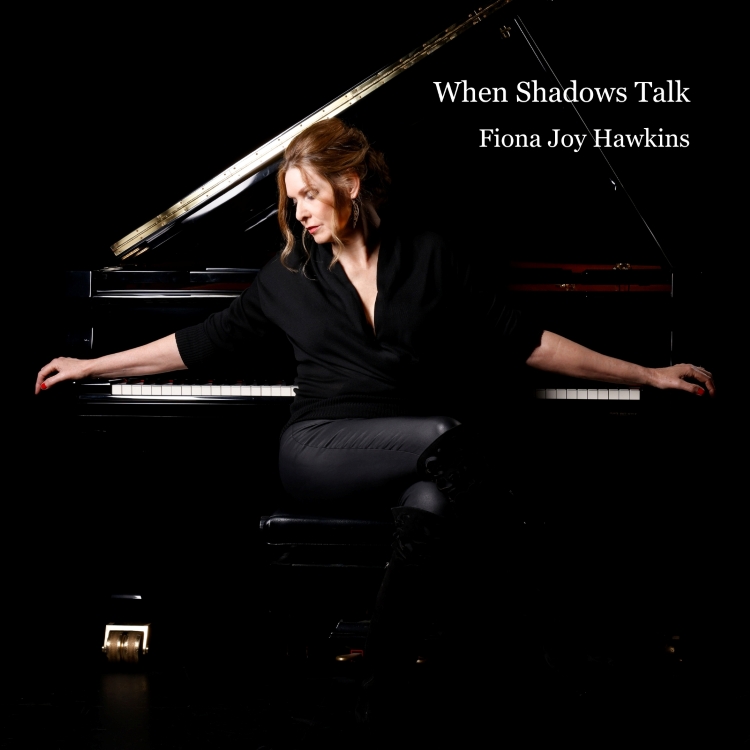
Fiona Joy Hawkins - When Shadows Talk |
|
It had been a while since we sat down with Australian composer and
pianist Fiona Joy Hawkins, who has performed internationally and
exquisite music has resonated with fans all over the world. In this
conversation we talked about her album When Shadows Talk.
She begins by explaining why she refers to her music as Neo Classical /
New Age, “Neo
Classical means derived from the Classical period. You have the Baroque
period, the Classical period, the Romantic period and a whole pile of
smaller ones and I guess that has led up to now and I think that is Neo
Classical. New Age means something a little more connected and it means
being connected and spiritual, but without any religion. It says
something about the world around us and it has a deeper meaning. A lot
of music has gone before us, going back to the Gregorian chant. One
music period develops and grows from another.”
The music is Neo Classical / New Age. You have a concept and you write
about that and hopefully they (the listeners) understand where that
piece of music comes from. Really, music has no value unless it has
value to the listener. You hope when they are listening it takes them
somewhere else in their own space and they connect with the piece of
music. That is usually what happens and that is the beauty of
instrumental music. It can mean whatever you want it to mean.”
You dig deep and you go to an emotional level you are going to be if not
inspired, certainly touched by something. If you listen to the news
something is going to touch you and affect you. If you leave yourself
vulnerable and open to all of that. All of the songs have got their
roots in that six-week period.”
As for the other people who had a role in bringing this album to life,
“I have a producer Peter Stevenson and he was amazing. The piano tuner
was incredible because on that day we had to pick up and
move to another location. The studio that we were recording in is
made of steel, so it was a winter morning and when the sun comes on the
building you get expansion. We were getting all of these cracks (the
sound). All kinds of things were recorded there before, choirs and
bands, but he had never recorded a quiet, intimate piano album, so that
problem came out for the first time. We realized after forty-five
minutes we were not going to get a recording without the cracks and the
pops.
He had been setting up since four o’clock in the morning and we had to
pack up and move. We got on the phone and (checked with) the local
studios within a two-hour drive, because we live in rural Australia. We
were never going to get something on that short of a notice. I said to
Peter look I’m forty minutes away, and I have a beautiful piano at home,
but it has two broken strings and it is out of tune. He said no problem
I went to school with Tony Prince the piano tuner. He said Tony will do
it. I said Tony is booked up three weeks in advance we will never get
Tony to tune my piano that quickly. He said it will be fine. Tony
dropped everything and he literally came straight to my place. I spent a
thousand dollars on these big felt sheets, because I don’t have a
recording studio here. You can hear dogs barking or whatever. I covered
the walls with those sheets.
We came to my place and by four o’clock that afternoon we had the piano
tuned and we were ready to record the next day. We did have to bribe the
piano tuner for everything else he was doing for three days. He moved
into my house, because the piano would never hold tune, as he had just
fixed two broken strings.
Everybody just went an extra mile and I feel incredibly blessed to have
it. It is like it was just meant to happen. During that recording
session we had a truck and a helicopter, a two-hour power outage, dogs
barking, cars going past and we had a microphone lead that we had to
replace. We had all sorts of noises and interruptions. I hit the wall on
day two. They had to send
me to bed and said Fiona come back tomorrow, just get to sleep. It was
really a tough project and to bring that to life took a lot out of me. I
am very proud of everybody who stood by me and who dropped everything
and made it happen,” she says.
Turning our
attention to the third song on the album “Lava and Snow,” Fiona Joy
Hawkins says, “I don’t know if you know about the volcanic ice fields in
Reykjavik in Iceland. They have this YouTube channel around the clock.
They have four cameras on the volcanic field.
Nothing happens. It goes off once every three or four months, so
you are watching nothing. It is addictive. They talk about geology and
(other) things. I just love it. I looked (back at) my screen and it was
bright red, because the volcano had just erupted. That is what inspired
“Lava and Snow.”
It was winter over there at the time and it was also snowing. It was a
fantastic display on my computer screen. I went to Iceland to get some
video footage. I made a video to go with every single track. They are
all on my YouTube channel. “
As for the second song on the album When Shadows Talk, “The
Ghosts of War Are Marching,” she says, “I have always felt incredibly
sad for the people who lose their lives fighting for a cause and it
doesn’t matter what the cause is, it can be any cause. Sometimes it is
without ceremony and it is without victory.
During that
six-week period I had been watching a bit of Game of Thrones. It
is kind of that idea of the “White Walkers,” who just pick back up and
they keep going. There is always war and there are always things
happening around the world. What if these people just picked back up and
kept on going and
kept on fighting
for what they believe in and actually found their own justice.
I wanted to do
that in a way where you could hear that unevenness like in the Game
of Thrones. It is uneven enough that it sounds like the subject, but
I didn’t want it to sound like a wobbly piano player. That was the hard
part to make it sound purposeful and not wobbly. That was the goal of “The
Ghosts of War Are Marching.”
That was merely absorbing the news and thinking what of all these
people. What have they actually got to achieve? What have they lost
their life for? That is where that song came from.” Let’s talk about the seventh song to appear on the album “Outside the Circle.”
“I have always said in the music industry I am always outside the
circle. You have a defining style that gives you what is unique. People
do not know where to put you. You don’t quite fit in and you really have
to accept that. You have to take what you are given. You are not
mainstream; it is a little bit harder writing contemporary piano music.
Being outside the circle is a place I have to be happy with. I don’t
want to earn my career writing covers, because the minute I do that I am
no longer a composer. I want to be a composer, so I have to take the
high road. In that moment of self-reflection, you go deep into your
values and why you do it. You just have to smile and say yeah, I’m
outside the circle and I am happy to be there,” Fiona Joy Hawkins
explains.
Earlier this year,
2026, Fiona Joy Hawkins collaborated with Steve Horner, to record both
the album
Quickening
and titular song.
Her level of excitement is easy to detect in her voice and her eyes come
alive when she says, “Wow, I got to work with Steve Horner which is just
amazing. I have a couple of albums with Snafu Records and so does Steve
Horner. It is a Swedish record label partially funded by Agnetha
(Fältskog) from ABBA.
Snafu Records have been trying to get their artists together to do
collaborations. They are saying we will get some amazing stuff. It is a
quite aggressive and modern record label.
They wrote to me and said we would like you to consider doing
something with Steve Horner.
Why would he want to collaborate with me? Think about this! He
did. He wanted to! He loved Wyndam Hill and he loved everything that
came out of that space. I thought this is really going to be
interesting, because Steve is a piano player. We did it and we thought
we have nothing to lose. He sent me over the orchestration that he had
done. I did a whole part of vocal cuts and I sent them back and that is
the song we created. I made the video and we both love it. We are
actually going to try to do some more work together,” she says in
describing the creation of the song with the Celtic lilt.
Steve did not tell me why he wrote the music and it is an interesting
way to work. When I came back with that, he said we are on the same page
here. He had written it about Imbolc which is a Gaelic
traditional festival that is celebrated. It is an Irish festival (Lá
Fhéile Bríde) marking the feast day of St. Brigid, who is Ireland’s
patron saint (editor’s note: actually one of three patron saints. She
is also a saint recognized in Scotland as is the festival, known as Là
Fhèill Brìghde.)
I did the video and wrote music and we hadn’t even discussed that and we
both came up with exactly the same thing.
It turns out that St Brigid used to dance around fires and she is a new
growth goddess. I went to Scotland and I got the video footage of the
landscape. I don’t think of myself as a singer. I think of myself as a
composer, piano player and I just happened to do this (vocalizing for
this song). It just worked and I now have all sorts of people asking
me to sing on their projects.”
Because Fiona Joy Hawkins has become very good at creating appropriate
and often stunning videos to accompany her music, we wondered if she
presents her music in live concerts, with the videos playing.
“I do and I did it for the first time last December. I thought I would
play the videos. I had the piano setup in front of the video screen and
people could watch the videos while (they listened to me).
Eight out of ten people loved it and two out of ten people said
they found it distracting.
When I did the videos, I did a special edit for the concerts and I
backed out me playing. I backed out as much as I could, but there is
still a little bit of me playing, so where I was playing on the screen
was not matching what I was playing on the piano and that is what
distracted them. The next time I will create videos without me playing
or put me playing in slow motion, so there is just no question there is
a connection,” she explains.
Now Fiona Joy Hawkins’ fans can watch her videos set to music, on
Spotify.
“I have done so many concerts over the years and a lot of them have been
recorded, not all of them, but particularly during COVID I had a Friday
concert series and I did live concerts with a number of people who would
join me in my home. It was during the lockdown. Plus, I have concerts in
China, I have concerts all over the place. I thought these concerts;
nobody is ever going to see them unless they were at the concert.
I have the videos, so what do I do with them. I thought what if I
repackage them and add in some extra banter and talk about things and
put them out as podcasts, because they are about the right length. have
done about four now (at the time of the interview) and I have about
sixty-five recorded. I thought every couple of weeks (I will add one).
It is a lot of work. I think bit by bit I will get them all out there.
People love them, because they are real. If they know my music, they get
to watch a concert and listen to it.
I think it is a good project for me to do,” she says.
Listen to more
Fiona Joy Hawkins music and purchase it at
bandcamp.
You can also
follow
Fiona Joy Hawkins
on Instagram.
#FionaJoyHawkinsInterview #AustralianComposerPianist #WhenShadowsTalk #FionaJoyHawkinsEntrevista #RivetingRiffs #RivetingRiffsMagazine #MujeresEnMusica #WomenInMusic #CompositoraEntrevista
|
 Segueing
into talking about the album, she says, “In 2024 I figured it was time
that I recorded another album. I wasn’t really inspired. My husband
(Bas) was going to work overseas for six weeks, so I thought okay
Segueing
into talking about the album, she says, “In 2024 I figured it was time
that I recorded another album. I wasn’t really inspired. My husband
(Bas) was going to work overseas for six weeks, so I thought okay