 |
Iris Jacobs Dutch Filmmaker At Home In Spain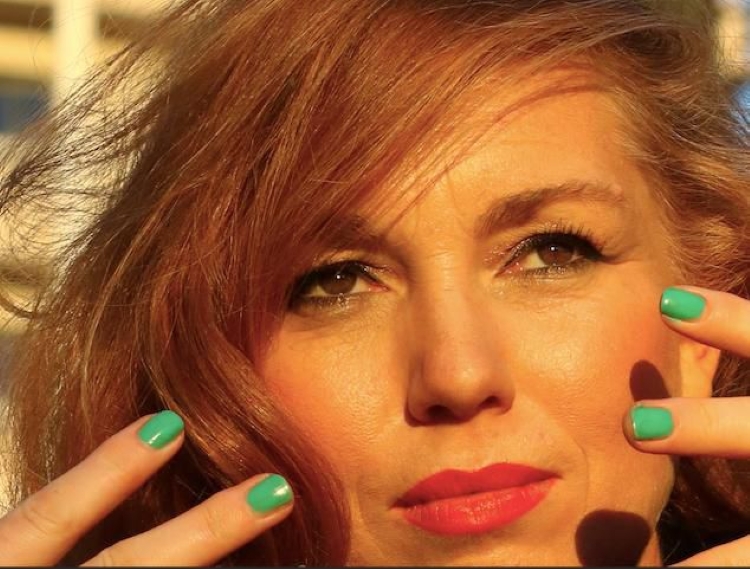 |
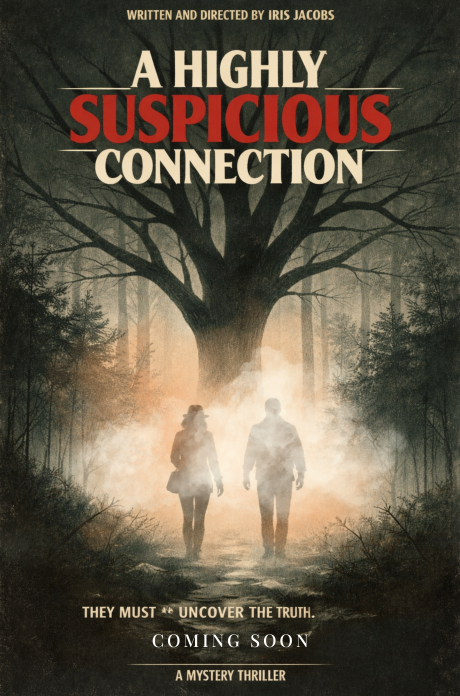
It is A Highly Suspicious Connection. No, those capital letters
were not us screaming at you, but they are the title of a film by Dutch
screenwriter, actress and
director Iris Jacobs, who for the past ten years has called Barcelona,
Spain her home.
“I started this project during the pandemic. Lots of things were going
on in the online atmosphere and I was seeing a lot of things going
around, especially with conspiracy theories and polarization was already
happening there. Then I had an idea to write a romantic comedy thriller
and to combine these elements. It is about these two characters that
represent these polarizations. They are sort of opposites, but somehow,
they are the same. They were both trauma informed polarizations, but
they have different coping mechanisms. You have a spiritual wanderer who
is in the misty countryside and she is going to have a date with an
ex-military man. He is extremely suspicious and he thinks that he is
being recorded all of the time. He is going to meet this woman in the
countryside.
They seem to be different, but they sort of have a similar trauma and
that is also why they are really attracted to each other. They are also
very reactive in their relationship. They find a stranger bound to a
tree. They go on this mission together. The guy bound to the tree
appears to know more than they do. They have to collaborate to figure it
out. Of course, they fall in love (not the guy in the tree).
 It
is going to be a feature for sure and it is inspired by Hitchcock, who
is one of my great heroes. There are also elements of Billy Wilder and
the more Nordic filmmakers. I am sort of heading there. It is a very
tight script as well. It is also surrealistic with a lot of suspense,”
Iris Jacobs explains.
It
is going to be a feature for sure and it is inspired by Hitchcock, who
is one of my great heroes. There are also elements of Billy Wilder and
the more Nordic filmmakers. I am sort of heading there. It is a very
tight script as well. It is also surrealistic with a lot of suspense,”
Iris Jacobs explains.
Iris Jacobs, who until recently solely focused on short films and
theater in various capacities, has, as we counted five different feature
films at different stages of development and she recently received high
praise and Best Female Director Award at the Barcelona Film Festival,
for her work in short films, more specifically the award was for
Conclave Clandestine, which featured dancer Anna Soler Canet and
dancer / actor Marc Comellas.
No matter what country you are moving from or moving to, it sometimes
takes a long time before you are embraced by your new home, but it
appears that Spain and in particular Catalonia now feels that Iris
Jacobs is one of their own.
As for the film, “It was super challenging because it was pandemic /
post pandemic when we recorded it and I think we were still doing makeup
with mouth protection.
I think I wanted to explore how you can work with the body and with
storytelling. It is physical theater, but I wanted to implement suspense
and when two people get too enmeshed, they need to (rediscover) their
hearts and who they are. That was the basic idea of this film. I think a
lot of times the stories that you tell are triggered by something
seemingly insignificant in the beginning. I was walking through the
center of Barcelona and I saw something, a round parking lot and I have
a specific sweet spot for these kinds of places. This specific parking
lot was telling me that I need to shoot something here.
I spoke with Anna Soler Canet and she is friends with Marc Camellas and
he is also an actor. I was so intrigued by him, because he is so amazing
in everything. He is an amazing dancer and a very good actor as well. It
was a wonderful project to do together.
As for receiving the award as best Female Director of the Year and being
embraced by the Spanish arts community as one of their own she (She
chuckles and smiles), “At least this is what I have been trying to
cultivate. I don’t believe in borders and divisions. I think we are all
part of the same family. When I came here, I was also in a place when I
needed to build something new for myself. I started to build a community
and to collaborate and to get to know people. One thing led to another.”
Talking about another feature film she has in development Sauna,
she says, “My partner always says, nobody can write a film as you do.
Sauna has been coming to the surface for years. It started with a
specific feeling and something I explore with my stories. The story
doesn’t always present itself to you in a very clear way in the
beginning and then it slowly unfolds. I had this idea years ago when I
made my first couple of short films. Fight Flight Free was my
first short film in 2018. I started it earlier when I was going to do a
shoot at Dusseldorf. I was working as an art director and production
designer for many years and I went to Dusseldorf for a commercial shoot.
I was in a car and it was raining cats and dogs and this eighties song
(was playing). I got these images
of an underground sauna in a hotel and it had a creepy
atmosphere. The hotel brought up images and it was parked in my head for
years. They came up again in 2019.
The core of the film is Stella who goes to a wellness retreat. A friend
of hers sent her there because she is stressed and burned out. She goes
to this resort and she finds out it is so eery. All the people promise
her she is going to be healed forever! She is going to be a perfect
version of herself.
Actually, it is getting weirder and weirder because they want you to put
your power outside of yourself and into the hands of these people. That
happens a lot. I see that in the smaller sense, but also in the bigger
sense. With leaders it is sort of the same. People put their power in
the hands of the cult leaders (she gestures) in the wellness (practices)
and they lose contact with themselves and trust their own guidance in
life. Then they are going to be vulnerable and exposed for these types
of treatments. They are actually retraumatized. I want to be careful not
to generalize, because there are also great people out there as well.
The person needs to learn to trust their own perception.”
We wondered if there were challenges or if Iris Jacobs had to adapt her
screenwriting going from short films to features.
“I have a feeling that my shorter films were just a preparation for my
longer films. Not only in terms of learning how to make a film, but how
to tell a story in a short amount of time, (in terms of) what is the
core of the story? What is the heart of the story? In the beginning I
was inspired by a super cheesy quote and maybe it is cheesy to share it,
but I am doing it anyway. (she laughs) It is a quote from Steven
Spielberg and it triggered me on a very deep level, “You dream is not
screaming in your face, but it is whispering in your ear and you have to
learn how to listen.” That is how I transitioned from working as an art
director and production designer and working as a theater producer for
many years, but in the Netherlands. For me that quote (says) you have to
really follow your heart and go to Spain, because there you feel you can
be inspired and catch these stories. That is to give you a bit of
context.
The first films
that I made were really coming from the place, I need to figure out who
I am. I need to figure out what my voice is. I need to make this film to
get rid of certain layers and then I can go to the deeper things, deeper
questions. and then to the bigger films.
Everything I
Didn’t Tell You,
one of the feature films that I am writing has (involved) very deep
research for many years. I am
interviewing fathers and daughters from all over the world. It is the
film (for which) I have done the deepest research.
I have been working on it for a long time and while I was working
on my shorts. That was my preparation for where I am now and I just feel
like to story is presenting itself to me and I just need to listen and
grab it.
It goes in a very natural and intuitive way. The main thing is I need to
make the space. I need to sit down and listen like Steven Spielberg said
and do the work. It sounds weird. If the idea is authentic and sincere
and comes from the beating heart of the story, the truth of the story,
then it will come back to you. It is harder if you aren’t making it a
practice. It is almost like a calling, I cannot, not do it. I heard from
somebody who said I am doing a lot of things, but the only time I don’t
feel l like I have to do something else is when I am writing. I want to
also try to experiment in the theater, because in the end it is about
storytelling. It is my passion and it is what I have to do,” she says.
That brings us to another question Iris, we heard you are writing a
play.
I want to explore more the physical side of everything, physical
theater, multi-dimensional contemporary theater. One of the projects is
called A Dinner To Die For (I think we will skip the dinner
invitation!). I applied for some residences here (Barcelona)
recently to see if I can do it in development there.
A Dinner To Die
For is
about six superheroes sitting at a table having a dinner and there is
one traitor. The queen has come to figure out who is the traitor.
Someone needs to be sacrificed (she says with an evil little laugh).
I do not have the full script yet. I have figured out the characters,
put them together and I know who they are. I know what kind of people
they are. They get certain prompts, this is your secret, this is your
goal, this is the thing you try to hide from this person. This is a
secret relationship you have with this person. I want to explore with
the actors what is going to happen exactly and to see what is going to
happen on things that I know and to explore them together.
That is one of the projects in the theater and then I have a Social Circle. It is about this underground elite world that is scrambling now and that we see with the Epstein files and everything that has happened in the world. I think this was already in my subconscious for years. I discovered this project while I was in the Actors Space close to Barcelona. It is an amazing place and I would recommend everyone go there. It is a place for writers, directors and actors. They have amazing workshops and you stay there for a week. The first one I did was directing performance. It was very insightful and I met amazing people there who are still my friends. I learned a lot. They have three pillars that resonate with me, the writing, directing and the acting. You cannot really see them separately. One of the things I was working on there was the Social Circle. When they gave us that assignment, we didn’t know somebody else was going to direct it. It was quite interesting and it turned out really, really good. It was also nice to see what the other people were (doing with) your idea.
This was the little seed for this project and it actually started while
I read an article about a mafia boss that was caught in one of his
underground tunnels in Italy. When he was caught, he was sitting there
in his leather chair with his little espresso cup. I thought it was such
a super cinematic image.
I started with that article and I thought that could be an interesting
arena where the mafia boss is sitting in his underground tunnels and he
sends out an invitation to his secret network of bad guys from all over
the world. They fell through the roof. They think they are at a super
inclusive ball where they can eat, drink and meet amazing, pretty women.
In the end it is a trap. They find it is an obstacle course setup by
ancient, successful, historical women. They are giving payback,” Iris
Jacobs explains, while describing the play as a dark comedy.
While we were on the topic of theater, we asked Iris Jacobs about her
role as Ivana, a woman on the autism spectrum in the play Calma Tensa
staged in Madrid during the summer of 2025.
“I have experience
in my life with people on the spectrum and therefore I think that is why
this role came to me. I learned a lot in (being close to people on the
spectrum). It was really special and I think it came in the right time
to give a place to certain things. I think it helped me accept things
about myself and my multi-dimensionality in the way that I experience
the world. It is different how the person on the spectrum is treating
you and vice-versa. You can still treat it as an equal container where
you have equal respect. Also, you need to see what the other person’s
part is and what is my (responsibility). Where can we meet and where can
we not meet.
It was a beautiful experience to be in this laboratory play with Majo
Cordonet who is an amazing woman. (Editor’s note: Majo Cordonet is the
playwright and director) To be in Madrid for three months was supercool.
It was an intense play. It was the end of the world in the basement with
neighbors (the play not Madrid!!). I was also the bad news
bringer. Acting is also something I truly enjoy,” she says.
There I bet you the readers thought we were done. Not yet. Iris Jacobs
is an accomplished visual artist, who just returned from an exhibition
of her work in Amsterdam, where she also conducted analogue collage
workshops at the University of Amsterdam.
“Now I see it as part of my practice and as an art educator and maybe
using the collage as a form of helping storytellers.
It is analogue collage. I make everything from old photographs and old
books and with scissors. When it is finished, I scan it and print it,
but I also sell the original. They are fine arts, limited edition,
prints. This has been ongoing for years. I started to experiment when I
was still and art director. I had to make many filmsets and art, so one
thing led to another.
There was a time when I said to myself, you cannot do all of this,
because it is too much. At some point I realized it was part of my
process because it is informing my screenwriting. When I work with my
collages, I create certain headspaces where I can catch my stories. Now
it is just part of my creative process. I create something in the now
and in the future,” she concludes.
The easiest way to
stay up to date concerning the films of Iris Jacobs and her artwork is
to follow her on her Instagram pages,
here
and
here.