|
|
Paul Rappaport Live By Request |
|
In the spring of 2025
Riveting Riffs Magazine interviewed Paul Rappaport, about his three
decade career, and then some working in the music industry first at
Columbia Records where he ascended the corporate ladder to eventually
become the Vice-President of Rock Promotion Having said that we do not
want you to get the impression he fits the stereotype corporate image
because as his career demonstrated he at times lived on the edge in
terms of taking what others may have considered to be risks, but he had
the vision to knew they would work. That brings us to this conversation
about how he parlayed his career at Columbia promoting Rock music into
becoming the executive producer of a A & E’s Live By Request show
on television for eight years.
He shares a personal moment with us, “There is something very
interesting and I want it to come out correctly. When I was growing up,
somehow my mother would say to me, listen Paul you were born under a
lucky star. I said ma what are you talking about and she said, I see
what you do. Other kids were playing baseball outside and I was at home
in a homemade laboratory, because I was enthralled with NASA and the
space race, I was learning how to build rockets and rocket fuel (From
what we know there were no holes in the roof of the family home!). I
do feel at this point in my life and I don’t know how, but I have lived
a blessed life. I don’t know if somebody up there (he points up and
his voice trails off) Maybe in a past life I did enough good things
and now I get to have this life. Maybe I did enough good things in this
life and maybe the next life will be better.”
There was another conversation, or perhaps two,
that at least from this writer’s vantage point was also pivotal
in terms of shaping Paul Rappaport’s approach and perspective on life.
That conversation was with his friend, David Gilmour of Pink Floyd.
It started off with Gilmour saying, “We are only here in the now.”
If you listen to AC DC, on an album, you will feel like you are in the
band. You will feel like you are standing next to the bass player. When
you hear things digitally it is like bricks of sound. If you turn the CD
up and loud you will just get a headache. It doesn’t enter your body in
the same way. They are getting better at the overtones and they are
getting better at all of this. Analog is just better. I was lamenting
this with Gilmour. He was lamenting this, because he is a guitar player
and he was saying hey my overtones are gone. He said I don’t hear the
magic.
David said Paul we
are only here on the earth for a short period of time. We are only in it
for the now. We don’t know, maybe somebody will invent digital that
overcomes this. We are in it for the now and maybe there is a future
when we will see or maybe we won’t see.
He also understood his place in history. He used to tell me I don’t
really understand all this big stuff about Pink Floyd. I know we are
really good and we have made a big difference, but we’re not god. This
isn’t Mozart, this is Pop music. Why is everybody making such a big deal
about us? He meant it. He is proud of Pink Floyd, but he kept telling me
this is just Pop music. What’s the big deal.
David Gilmour is one of the most well-grounded people I know and
he also has one of the biggest hearts of anybody I have met. The only
reason I was standing on stage with Pink Floyd as a thank you, was
because of him and Nick (Mason). Hey thanks so much. Come and play in
our band for a song. You mean at a rehearsal, right? No, a proper gig.
You want me to come to London and play live in the London arena and play
in front of 15,000 kids. I get to be in Pink Floyd for seven minutes.
Who does that? What kind of people do that.
First of all, it is a business where you don’t expect thank you. I have
had wonderful things happen. I have had guitars given to me. I never had
anybody know how much it would mean to me as a guitar player, to be a
part of a band like that and to experience that,” recalls Paul
Rappaport.
So, let’s go back to when your career transition took place, when and
the how of it.
“I had done twenty-two years of promotion and after we broke the band
Alice In Chains, which was probably one of the hardest things I ever
did. I just felt like I was done. You never know in life when you are
going to come to an end and I started doing everything I could do. Alice
In Chains was a big deal because it opened the Seattle sound. There was
a Seattle sound before Alice, but with Alice we broke through to
mainstream radio. That was a big, big deal, because it opened the door
for Pearl Jam, Nirvana and
all of these other bands, because radio embraced this new sound. I
thought I was repeating myself and I had ideas. I was very familiar with
the radio medium of the different ways that I could promote music beyond
being in charge of Rock radio, getting records on the air, getting a big
promotion and complimenting a tour. This is your typical stuff. I went
to the president Don Ienner and I said Donnie I have a bunch of ideas
that could help us, call them creative marketing ideas. I want to offer
that I can do this. I didn’t give him that many specifics and he changed
my life. Most record company presidents would say, twenty-two years in
promotion, great, here’s a check, thanks, do whatever you want to do in
your next life.
He was intrigued, because he had vision.
He said if you think you can do these things make up a title and
I will give you a budget for a year and let’s see what you can do. To me
that is visionary and it spoke to how our business was really built by
visionaries. He said why don’t you become the Vice-President of
Imagineering or something like that. I said nobody is going to take that
(title) seriously.
I decided I was going to do some broadcasting, because I had done a lot
of live radio broadcasts and bringing the audience to the Rock show
right as it is happening. I was familiar with this kind of thing. I
started a creative marketing department. I was twenty-two and one-half
years into a thirty-three-year career. I gave myself the title of
Vice-President of Broadcasting and Event
Marketing. That covered a big range of things. Not only was I
doing broadcasting, but event marketing to me was getting thousands of
people to look your way. If you read about the Pink Floyd Airship, that
is event marketing to me. This is an event and you are going to travel
all over the country. It is going to blow people’s minds and give rise
to fans,” he says.
As an aside he launches into another such event to illustrate his point,
“I wrote in my book that I had Will Smith, before he had his faux pas
and he was still a popular actor and a rapper. We had a record with Will
Smith. I had him appear out of nowhere in front of the Virgin megastore
on Broadway in New York. It took two magicians and two illusionists to
create. Imagine there is a stage and there are cameras everywhere. He
was going to Rap a few songs and then go into the store and sign some
autographs, but I wanted him to appear in an illusion and blow people’s
minds.”
Paul Rappaport
talks about the live radio broadcasts of concerts that he did in the
1970s and you can read about them in his book,
Gliders Over Hollywood Airships, Airplay and the Art of Rock Promotion.
“Somebody eventually realized it is a pain in the ass to do live
(actually) live. It is scary, all of the lines have to work and what if
something goes wrong. Bob Meyrowitz said why don’t we just tape
everything. If we tape it and give it to radio, they can run it whenever
they want. He invented this and for years all through the eighties with
King Biscuit Flower Hour, this was a mainstay of Rock radio.
I wanted to bring back live radio, because I thought there was something
really magical about you being there at the moment that whatever is
happening is happening. I liked that idea, because I came from that.
Bruce Springsteen Live at the Roxy. You can’t get into the Roxy in 1978,
but if you want to be at the Roxy, just listen.
I called all of my friends at Rock radio and at that time
singer-songwriters were starting to emerge with acoustic stuff. Everyone
of the Rock stations had an acoustic Sunday, because of all these new
singers-songwriters. I went to them and said what if I could bring you
live from New York? Let’s say it is eleven o’clock in the morning New
York time and it is eight o’clock on the west coast. It will be a star
or superstar that you know, but I am going to open it with three or four
songs from someone new. I am a promotions person and I wanted to get our
new acts up.
They all loved that idea, so I started the Columbia Records Radio
Hour. We tried to do it as many times per year as we could on a
Sunday morning at eleven a.m. I really got a kick out of it, because you
could be in San Francisco driving around at eight in the morning getting
bagels for breakfast and listening to the radio live from New York and
you are hearing Bruce Cockburn, Jackson Browne or Shawn Colvin or Mary
Chapin Carpenter. These were the singers and songwriters who were coming
along and it was super successful.”
Continuing he segues into another story, “Bruce Cockburn and I became
very good friends and I became a big fan. I suggested to Bruce, why
don’t we have a show every Christmas called Christmas With Cockburn,
whether you have an album or you don’t. A career is forever. You (Bruce)
can pick the artists (to be on the show). He loved that idea. Bruce is a
wonderful person and an incredible human being. One year he had Jackson
Browne as a guest and one year he had Rosanne Cash and Lou Reed with his
fabulous bass player Ross Wasserman. One year he has Youssou N’Dour from
Senegal and the whole band (Super Étoitle de Dakar) got flown into New
York. They did the song
“Chimes of Freedom.” There are two CDs you can still get, Best of
Columbia Records Volume One and Volume Two. Both are excellent,
because they are the best of the best. They are the best songs from the
best shows. The music is extraordinary and if anybody is interested, I
think it is Volume Two (that has) Youssou N’Dour and the band is
magical. They split the verses when the band is playing.
I said to these guys from Senegal, you are going to rehearse and Bruce
is going to do a set and I would like you guys to do a song together.
That was the idea of the show for artists to collaborate. You can do
your own song, but there is a collaboration. When are you going to hear
Lou Reed, Bruck Cockburn and Rosanne Cash (together). You are not. I am
getting ready to rehearse Bruce and Youssou, but there was no band. I
went to the road manager and asked, where is the band? Where is Youssou?
He said shopping. I said shopping. He said yeah, we are in New York.
That is a true story. I said do you know how much this cost and are they
coming back? (he is laughing while telling the story). They were
so professional, they came back in time and they worked out “Chimes Of
Freedom” very quickly.
That became a very popular show and it was so popular that I would get
calls from big radio stations at the beginning of December. They would
say listeners are calling and they want to know when Christmas With
Cockburn is, because they need to put it on their calendars. That is
how big that show became.
Then I thought let’s go back to live. I did a live show with Johnny
Mathis from Lake Tahoe and with a thirty-six-piece orchestra. I did a
promotion on one hundred stations when we gave candles away that said
Johnny Mathis and then whatever it was. The idea was you have dinner
with your loved one, light your candles and listen to Johnny Mathis
live.”
He pauses to catch his breath (he can get quite animated when
reliving these memories) and then continues, “Now I wasn’t just Rock
anymore. I could do anything, I could do songwriters, I could work with
Mathis, I could work with Tony Bennett and he and I became great
friends. I said let’s do a show with Tony Bennett, but I always liked to
tie in a holiday, so there would be more of a reason. Johnny Mathis
might have been a Valentine’s Day special. Tony asked (his son) Danny
Bennett, who managed his career, can we take requests? I had to go to my
engineer and ask how we could do this? He said I have to get a special
box, so when a call comes in, it goes into the recording studio
correctly. It was Tony Bennett live and we are taking requests. This
radio show was so extraordinary. He would be talking to somebody who
(might say) Tony you have meant so much to me and the guy is calling
from Cleveland. Tony is going hey is that restaurant still there. Now
they are talking about it. If you are listening vicariously, you are
loving this, because you are talking to a superstar, but he just wants
to talk to you about your life. It was one of the most amazing radio
shows I ever produced. Danny walks out of the studio and he looks at me
and he goes; this is a television show. I said it is. Danny had a lot
more experience than me, because he managed Tony.
I went back to Sony and we had a TV department and a small production
company. I said I just did this and Danny thinks it is a TV show, what
do you think? They said we think you’re right. Write up a proposal. I
went over to A & E and I sold them the idea of the show. I said you have
to understand the music is the music, but when people get to talk to
Tony Bennett it becomes a bigger smile. This could be something bigger
than life. They said okay let’s do one. We did it with Tony Bennett and
it took us a month to come up with three words to describe what this TV
show was. It was Live By Request and they asked since it is going
to be on our show can we call it A & E’s Live By Request. We said
yeah. We, Sony, retain ownership of the show, but sure. We license it to
you. Tony won an Emmy. Here is the big joke about it, the first twenty
minutes of that show there is no audio.
Because A & E wasn’t used to doing things live, as half of their things
were documentaries or about people who had passed away and they were
dealing with dead people. We were live on A & E and people could see
Tony, but they couldn’t hear him. The A & E people are screaming at us
in the studio. It turns out it wasn’t our fault. A & E had two buildings
and one wasn’t talking to the other.
We thought disaster, everybody’s going to tune out. Lo and Behold A & E
comes back and when you hear an artist talking to you normally and not,
I’m a star, it was an extraordinary show. They said, do you want to do
some more of these? We were like really? They said yeah. I started going
through our roster.
The next thing they say is, this is a hit TV series and we want more.
Now I have to go back to Columbia and say we have a hit television show
that I created with Automatic Productions. The first thing I was told
was no, no, no we don’t want a TV show. We are a record company. I went,
of course you want a TV show. You keep begging to get artists on TV
shows and you have your own TV show (he gestures like what don’t you
get about this?) You don’t have to beg anybody and it is two hours
of Prime Time. They were afraid, because in order to build a TV show you
have to go into the red for a little while. Tommy Mottola and his
right-hand man was Al Smith, ran Sony and not just Columbia Records. Al
said Automatic Productions will take this on, but I need Rappaport to
remain as the Executive Producer, because I had told them here is the
downside, we are going to get everyone of our artists on there, but we
are going to run out of artists, because it is a big hit television
show, but you still own the show. If someone makes a DVD Sony is going
to make money. I can’t let it go forever if you don’t let me have other
artists. I said just open your minds, so we did forty shows of Live
By Request. We did all of our people Kenny Loggins, Michael Bolton,
Gloria Estefan and all of our people. We also did B.B. King, Elton John,
we had our guy Willie Nelson and we did Neil Diamond, again our artist,
which was the biggest one we ever did.
There were other people who wanted to be on our show. Barry
Manilow wanted to be on our show, because when you did this show,
essentially you are playing your catalogue. It is a request show and the
band rehearses twenty-five songs, because they don’t know what is going
to be requested. Hello here is the good news, they debut three of their
new songs, because everybody launched new albums with it. David Bowie
here is my new album. Here are three songs. It didn’t matter who you
did. The Bee Gees was another huge one. You are promoting your new
album.”
Paul Rappaport takes time to talk about some of the challenges and some
of the surprises, “Music on television for some reason is a wall, but
our show worked backwards and when you talked to the artist you walked
through the screen. That happened by accident.
I had to learn how to make television shows. I am a music person and I
know how records are made. I am a guitar player. I didn’t know how to
record TV. I didn’t have a clue how to produce a TV show. How does
everything work? How do the politics work? It was a lot and honestly
after the first four years the pressure was so overwhelming, because I
was out of my element. I was dealing with TV people and sadly some of
them were very duplicitous. I didn’t have a lot of good mirrors around
me They twisted me in ways that I didn’t even know I was being twisted.
I was in charge of producing three DVDs at once. That was a brand-new
thing for me, how did DVDs work? It is going to be live and it is going
to be surround sound. They were asking me questions like where do you
want to be when you watch it? What row in the audience to you want to be
in?
The first four years of Live By Request was so stressful that I
actually had a nervous breakdown. I am not that intense, but I became so
wound. We were very successful and the first year of Live By Request,
we built it from nothing. We get to a place when we
were doing Willie Nelson, who is a friend of mine. I am in the
phone room and Willie says how are you doing? The caller says I am doing
great, now that you are on Live By Request. I went oh my god they
know Live By Request. It was a brand now. You dream about that
day that people talk about the show. I went we finally got there.
I could write a whole book about the Live By Request television
experience (he should). I had a whole other journey, a television
journey and I am a sponge I wanted to know everything. I wanted to know,
how does the director make this decision? How does the lighting work?
How does the sound work? How do the contracts work? I wanted to know
everything, so I would be a good television producer. I became a good
television producer, because I understood not only the artists, but what
the network wanted? They get a vote. That network was giving us
something like four hundred thousand dollars per episode. Then I would
go and find another one hundred thousand dollars from a record company.
The shows were five hundred thousand dollars productions. That is a lot
of money. The one we did with Don Henley, because it had to be done
remote, was one million dollars.
The A & E people were used to working with dead people and they aren’t
used to artist demands. They don’t get it. I would go in and say James
Taylor, wants this and he wants that. They would go hey, what the…. This
is the way it works. I went no; no this is the way it works if you are
dealing with James Taylor. Do you want James Taylor to be on television
and have a frown and have him tell two million people watching, this
network gave me a hard time or do you want a smiling James Taylor? It
took them a long time. They are not used to doing live and they are not
used to dealing with artists.
Every time that I brought something to A & E that was a different
request or a different idea for the show they were like why isn’t this
just a formula? I said you are dealing with artists and I have been
dealing with this my whole life. I have to make a compromise. I have to
tell them this and you have to walk this way otherwise you aren’t going
to have a smiling artist and you want smiling artists. The James Taylor
show was so nuts I got kicked out of A & E. Paul Rappaport is not
allowed in A & E anymore.
I had to worm my way back in and say look I am not a demanding person,
but you need to understand what you are dealing with here. You made a
promo for the Bee Gees and I showed it to them and they didn’t like it.
They don’t want it. They want it to say something else. You need
to change it. They said we don’t change stuff. I said you do for an
artist, because they are in charge. I had to train them. They went along
kicking and screaming. Everyone of those shows had its own adventure.
The person who was in charge of long form event programming always felt
that she needed to make sure that god forbid a show happened without any
of her input. She wanted to make sure that she had input on every show,
so that her job mattered.
Every time I brought in a new set and these sets cost about thirty
thousand dollars and each artist had a different set for their TV show.
Every set I brought to her she commented on it and she made a change to
justify her (job). Tony Bennett was so popular that we did three shows
with Tony. Tony was an artist, besides being a singer, he was a fabulous
painter, in watercolors. We hung all of his paintings as the background.
She walks in and goes there are just too many paintings. I was like
really; this is just the background. We aren’t zooming in. This is not
an art show.
I went to her second in command and I said every time I put a set
together; she has to comment. He said I know, she has to feel like she
is part of the show. He said I am going to give you a hint, whenever you
bring a set to us, put something in it that doesn’t work that you know
is so off and she will say Paul I like everything except this one thing,
can we change this one thing. I said that is a good idea. This is what
was happening behind the scenes.
For the Barry Manilow Christmas special the stage is inside and outside.
He is going to walk through a door and it is going to snow. He is going
to be outside. It is made up. I told the set designer, right in the
middle of the set I want you to put a 1950s jukebox. He said why do you
want that? I said just trust me. Put it right there, before he walks
outside. He said okay. She (the programmer) gave me a call the next day,
this indoor, outdoor set, which was Danny Bennett’s idea, I love it, but
there is one thing I just really don’t like. Paul the jukebox just
doesn’t make sense to me. Would you be upset if we got rid of the
jukebox? No, that is okay, it doesn’t mean that much to me. She said, oh
thank you. Every set that I delivered after that there was always one
thing.
As an executive producer, you are really like a referee. You are doing a
live production and the director comes in and the sound man comes in and
I would come in and say what is the problem? He wants to put these
speakers here and I don’t want to see the speakers. I am the mediator.
We rehearse Tony Bennett and the Muppets are on the show and Elmo is
going to make a request. I rehearsed Elmo with the director. It was a
tribute show and there were so many tributes to Tony Bennett, from
around the world. Elmo was still talking to Tony and I didn’t know if
there was still time for Elmo to make a request. I say over the speaker
in the studio I am looking at the time and I am not sure we are going to
get Elmo’s request in. The director who is a friend of mine, comes
roaring into where I am, what the (expletive) are you talking about? I
rehearsed that (more expletives) puppet for three (expletive) hours. You
can’t cut Elmo’s request (We both break out in laughter.)”
Then there was the unexpected, “For the Eurythmics the two people who
called in one was Aretha Franklin and one was David Bowie, before he did
(his own) show. David called ten minutes early and the second in command
from A & E comes into the phone room and he said tell David Bowie to
call back in ten minutes, because I want it to go over the hour. They
were looking at the ratings. I said listen, I have David Bowie on the
line now and you do not tell David Bowie to call back in ten minutes,
because David Bowie probably isn’t going to call back in ten minutes. If
you want David Bowie, put him on after this commercial break, otherwise
we are going to lose him.
Bowie gets on and he is talking to Dave Stewart, but the people are
looking at their watches and going hey. Alright David, it’s nice talking
to you. Thank god it is over. This segment can only be so long and it
has been a long three minutes and then Bowie says is Annie there? I am
thinking didn’t anybody tell David Bowie what is going on? Now it is
another two minutes with Annie Lennox. It is a wonderful segment and
nobody tuned out. We went to the commercial break and the host Mark
McEwen looks at the camera and he says, we are going to take a
commercial break right now, but before we do, you see this thing in my
ear, the producers talk to me in my ear. I know it is long and they are
telling me cut it off, cut it off we have to go to a commercial. He
looks into the camera and he goes, how am I going to do that? It’s David
Bowie. It was one of the greatest television moments I have ever seen.
Then we went for a commercial break.
There are all these fabulous moments and crazy moments. For me the first
four years of Live By Request were hell on wheels. The second four years
I was a lot less nervous and I had the time of my life. It is not that
things didn’t go wrong, but it was much easier. Once I realized I was
fine and it was the people around me who were making me crazy. I thought
just trust your instincts, don’t trust all of these people telling you
stuff.
Do yourself a favor and read our conversation with Paul Rappaport from
the spring of 2025 about his book and working at Columbia Records. You
can
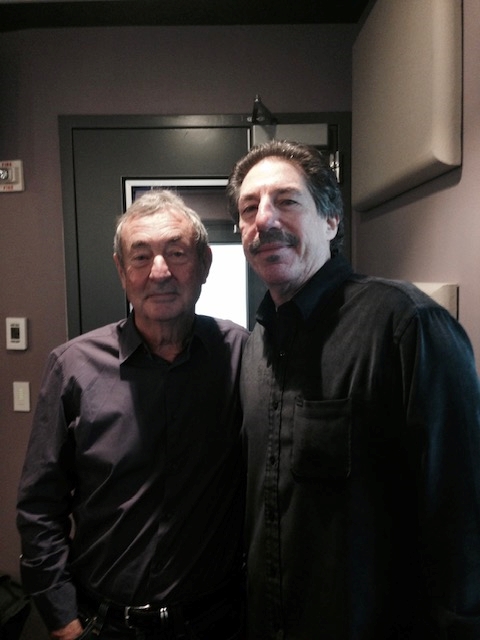
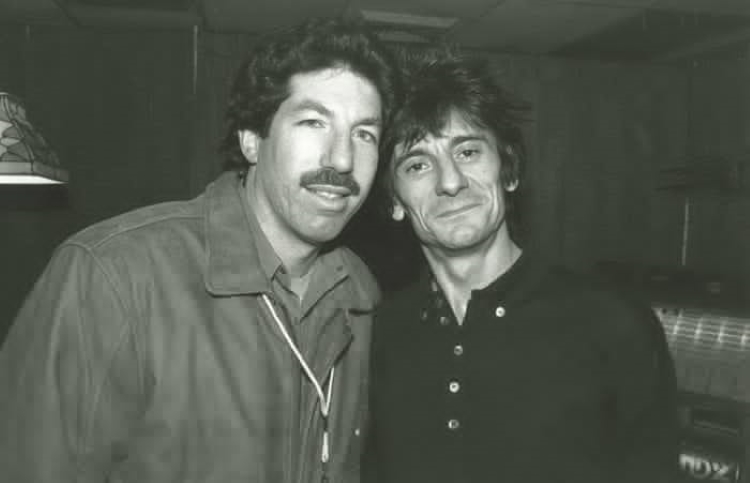
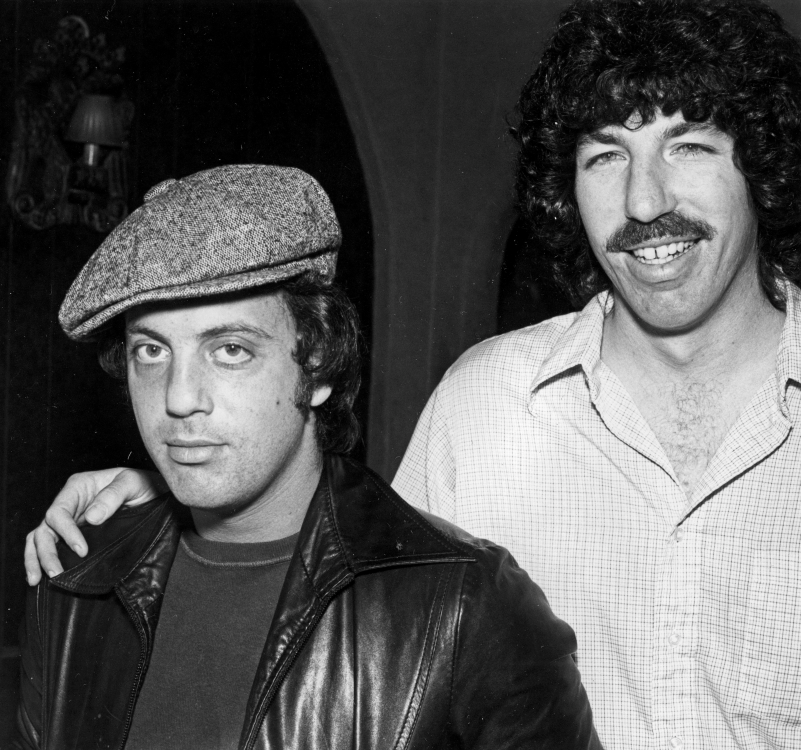
read it here. Top Photo Paul
Rappaport and Ronnie Wood of the Rolling Stones; Photo Two Paul with
Billy Joel ; Photo Three Paul with Nick Mason of Pink Floyd. #PaulRappaportInterview #PaulRappaportColumbiaRecords #RivetingRiffsMagazine #RivetingRiffs
|
 “David
said that because we were lamenting the CD when it came out. Vinyl the
fidelity is magical, but with digital it is just blocks of sound. They
are getting better, but if you put on an album now it would sound more
live. There is something about vinyl. We used to call it black magic,
because it is black vinyl. There is something about the analog thing. We
don’t have chips in our head. We don’t hear digitally. We are analog.
“David
said that because we were lamenting the CD when it came out. Vinyl the
fidelity is magical, but with digital it is just blocks of sound. They
are getting better, but if you put on an album now it would sound more
live. There is something about vinyl. We used to call it black magic,
because it is black vinyl. There is something about the analog thing. We
don’t have chips in our head. We don’t hear digitally. We are analog.