|
|
Undercover (Mostly) - Stew Cutler |
|
Undercover (Mostly) the new album from Stew
Cutler does not describe some child hiding underneath the blankets from
an imaginary monster, but rather the superb guitarist covering seven of
the nine songs that appear on the record and adding to them two of his
own compositions. Let us say this and be completely transparent
throughout our history, Riveting Riffs Magazine has been a little
apprehensive of albums heavily populated by covers, because so often the
artists merely try to sound as close as possible to the original
artists, leaving you wondering why you did not just buy the original
record. That, however, is not the case with Stew Cutler’s Undercover
(Mostly). He has reimagined some iconic songs, arranged them as
purely instrumentals and given us a special gift that we will enjoy for
many years to come. So, we wondered at this
point in his career what would lead Stew Cutler to create an album like
this. He explains, “A while
ago a friend of mine came by to see me play and she is a manager person,
a producer person and she didn’t end up working with me, but I did for
many years work with her on her main project which is the Harlem Gospel
Singers. Her main comment was your music is really good, most people
don’t know any of these songs. Why aren’t you doing any covers? I don’t have a really
good answer as to how this all got going. I thought of it as a challenge
to take some songs that people knew and to turn them around a little
bit. I have been a little bit fascinated with songs that end up as hits
or top forties hits like the song “Betcha By Golly Wow,” the one that I
did on solo guitar. It was a top R&B hit. It is such a Jazz tune. So
many of Stevie Wonder’s songs were Jazz tunes. Now I can’t say that
about “Close To You,” I am proud of the arrangement on that. It was a
little different and I included a drum solo out of respect for Karen
Carpenter. It was played by Bill McClellan. I introduce it on stage as
Freddie King meets Karen
Carpenter.”
It occurred to us that
even those of a certain vintage may be familiar with many of these
songs, such as “Summer Breeze,” by Seals & Crofts, but many others may
be hearing these wonderful songs for the very first time. “That is something that
occurred to me too. A lot of these songs are tunes that I heard growing
up. There is nothing super contemporary there, so (voice trails off).
That is a good question and I don’t think I have a good answer. You are bringing up a
good point, because for some folks who hear this recording there is a
chance they may not be familiar with the original. Upon doing this
originally it never occurred to me. It is kind of after the fact. I
don’t know what to say about it. It is not something intentional or
unintentional. It wasn’t even
a thought. It is personal to me. It brings up the whole thing of
making music or any kind of creative art. This record is what I want to
hear and how I want to hear it. It is with the people I like playing
with and we work on the music together. At the end of the day, it is not
for me. Some people don’t get that. When all is said and done it is not
for you. Does that occur to every artist? I wonder about that. I was one of the few
people who was busy during the pandemic. I had a TV show. A good friend
of mine whom I have known most of my life Stewart Lerman got me hired on
the show The Marvellous Mrs. Maisel.
In that season they had a house band and a strip club and I was
in the band. Boy did they keep us busy. We were always recording and
filming. The thing I am trying to get to when I started playing live
again, I got on stage at one of the clubs I play at in New York and I
was thinking to myself what am I doing? After we played the first set
all of these people came up to me and said, oh when you play such and
such and I can’t believe you did this, blah, blah, blah. Then you
realize again that same kind of thing, it is not for you. You put it out
there and people get something out of it. It is not for you to judge
what that is or to decide what they are going to get or anything like
that. It is for the giving. You are a little bit of a preacher or
something like that,” says Stew Cutler. The album, recorded and
mixed by Dan Gross has a very immersive sound, placing the listener in
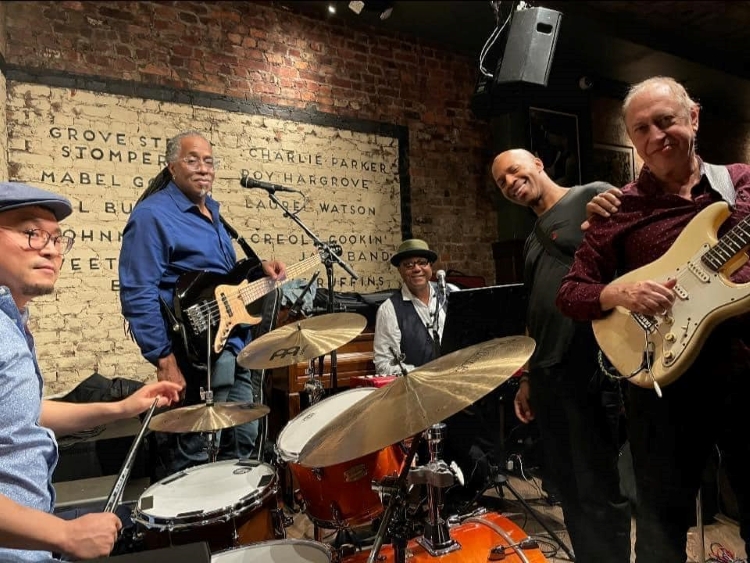
the middle of what almost seems like a live gig. “This is a group of
gentlemen that I work with a lot. I want to make sure I mention
everybody’s name. Bill McClean (drums), Etienne Lytle
(keyboards and organ), Chulo Gatewood (bass) and Bobby Harden on vocals
(two songs). We play out a lot and we are used to playing these
songs. We didn’t record it as a studio album with all sorts of layers. A
lot of it was played live and we fixed this and we fixed that. We added
a little something here and there. It wasn’t strictly live or live in
the studio, but it wasn’t super layered.” One of the things you
learn about Stew Cutler very quickly is that he has a humble attitude
towards his career and often deflects to others who he collaborated with
or simply were instrumental (no pun intended) in the decisions he makes. “Betcha By Golly Wow,”
was not my idea. I had to play it a few times in the studio, before I
got a decent version of it. It is not an easy song at all. I had to be
instructed by my wife, actually, because initially I had the melody
wrong and I worked on that. I must have played the song a thousand
times, before I tried to record it. Fortunately, it came out halfway
decently. That is a workout. I will play it live occasionally. If I have
a little stumble during a live performance, I don’t get mad at myself.
Let me put it this way, playing it live you want to play it perfect and
I can’t tell you that I always play it perfect. Maybe I can cover up the
little boo boos that I make, but I know I didn’t play it perfectly,” he
says. We beg to differ Stew,
your tender interpretation of the song is pretty and the arrangement
gives us a different take on the song, harkening back to what we said at
the beginning of this piece, why would you want to cover a song and then
strive to do it just like it was recorded before? With all due respect
for Jim Seals and Dash Crofts, we prefer Stew Cutler’s cover over the
original Seals & Crofts song “Summer Breeze,” which is not the same as
saying we did not like the original, but more we like the elegant take
that Stew Cutler and his fellow musicians give to this song. “One of the people I
consider to be a mentor is bass player Harvey Brooks and something he
was very proud of was his work with Seals & Crofts. Somewhere along the
line I gave another listen to Seals & Crofts and what Harvey did. How I settled on that
song. Why I settled on that song. I wish I had a good answer, but I
don’t. It starts with a bass solo by Chulo Gatewood, then we played the
melody. We modulate and that is followed by Tom Wilson (keyboards), I
have a solo. You have three
soloists in slightly different context. To me that makes for a good
instrumental. There are a lot of songs that are instrumental and the sax
player plays over the changes, then the trumpet player plays over the
changes. The piano player plays over the changes. That’s cool. I have
some music like that, but I find with my better compositions and in this
case my better arrangements have the different soloists in slightly
different settings. To me that makes it more interesting,” explains Stew
Cutler. He talks about his
decision to record Michael Jackson’s “The Way You Make Me Feel.”
“I was just trying to
find something hidden in there. That song is basically a Blues (song),
but who thinks of Michael Jackson as a Blues singer. We just felt very
comfortable playing it. I went off on a little bit of a tangent with it
and it was more or less live in the studio. It is a song that is
structured more as a Jazz tune, but it somehow made its way into Pop
radio. Things like that I find very interesting. With the Wayne Shorter
tune, “Fee-Fi-Fo-Fum,”
I went the other way around. That is a tricky Jazz tune with a
lot of changes. There is one section in Wayne’s version when there is
this bouncy Blues feel and the melody is almost this Blues guitar lick.
I tried to turn it into almost a Texas Blues.” As for the song “Buried
Alive In the Blues,” composed by Nick Gravenites and originally recorded
by Janis Joplin, Stew Cutler says, “I am pretty proud of my playing on
that. My original slide guitar playing all got erased by accident, so I
just went in and played all of that boom!
There is one note that I hit that is way above the neck and I
miraculously hit this one note. I am pretty proud of that. It came out
nice. I went for a Pops Staples vibe with that vibrato guitar and all of
that. I play harmonica for a lot of other people and not so much for
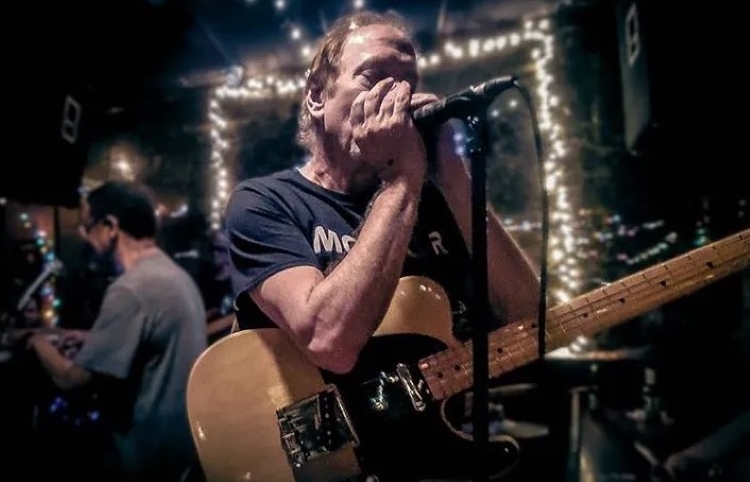
myself, but that is me on harmonica.” The song features the
vocals of Bobby Harden. There is a bit of
macabre trivia to the song “Buried Alive In the Blues,” that begins with
the song title, continues with the songwriter’s surname and on the day,
Janis Joplin was to record the vocals in the studio, she was found dead
in her hotel room. That is not intended to be humorous or funny, it just
makes you think. “The other song that we
have not talked about is the Crosby, Stills, Nash & Young song
“Country Girl.” There is just something about it, about the chord
changes and I wasn’t such a big fan of theirs when I was younger, but
they were great songwriters and unbelievable. The changes are kind of
Jazzy in there. There is something to it that I find interesting and I
like the melody. It is the only song that I actually broke out my Jazz
guitar to play some of it.
That is Etienne Lytle doing the organ solo at the end,” says Stew Cutler
Please check out Stew
Cutler’s
website and you can follow him
on Facebook. #StewCutlerInterview #StewCutlerMusic #StewCutlerGuitar #RivetingRiffsMagazine #RivetingRiffs
|
 The
interesting thing about “Betcha By Golly, Wow,” is that is almost
associated with the Philadelphia group The Stylistics and for good
reason as the single was a gold record that peaked at #2 on the R&B
charts in America and #3 on the U.S. Billboard Hot 100 chart. Here is
the thing though, The Stylistics were covering The Thom Bell and Linda
Creed song recorded in 1970 by Connie Stevens under the title “Keep
Growing Strong.” So, we might say that Stew Cutler recorded a cover of a
cover and reimagined it, just as The Stylistics reinterpreted the song
in their own way.
The
interesting thing about “Betcha By Golly, Wow,” is that is almost
associated with the Philadelphia group The Stylistics and for good
reason as the single was a gold record that peaked at #2 on the R&B
charts in America and #3 on the U.S. Billboard Hot 100 chart. Here is
the thing though, The Stylistics were covering The Thom Bell and Linda
Creed song recorded in 1970 by Connie Stevens under the title “Keep
Growing Strong.” So, we might say that Stew Cutler recorded a cover of a
cover and reimagined it, just as The Stylistics reinterpreted the song
in their own way.