

|
|
Adrian Sutherland Has a New Book |
|
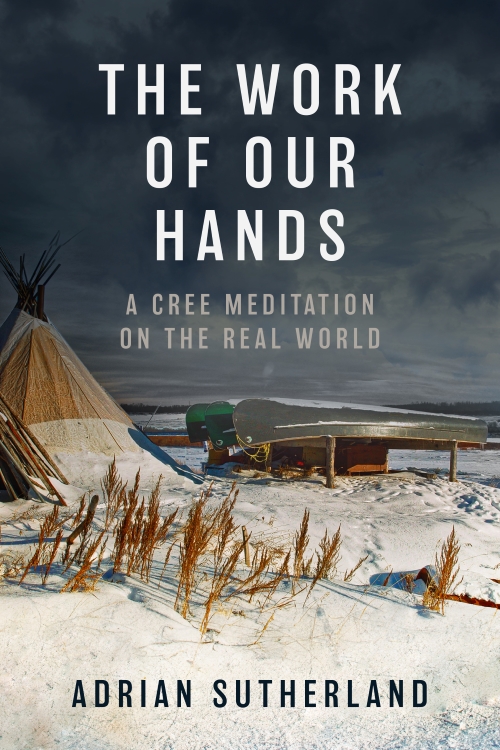
The book The Work Of Our Hands:
A Cree Meditation on the Real World, authored by singer,
songwriter and musician Adrian Sutherland is a book every adult should
read. It was written from
his home in Attawapiskat First Nation on the shores of James Bay,
approximately 1,050 kilometers or 650 miles north of Toronto, Canada (by
air). This may be Sutherland’s first book, but anyone familiar with his
music has come to appreciate the way he brushes his lyrics and music
against a canvas of nature and life, painting pictures that come to life
for the listener. Those qualities have stood him in good stead as a
first-time author, as this book although at times provides a narrative
to struggles with alcoholism (earlier in life), to being of mixed ethnic
heritage and trying to find his place and other subjects that we will
leave for the book, gives the reader a sense of being in the midst of it
all. This was the second time that this writer sat down with Adrian
Sutherland for a conversation and it is very easy to appreciate his
warmth (sorry Adrian, I know it is not warm up there right now!), his
humble and grateful attitude. This is not a book that was written to
puff out his chest to say look what I have accomplished. This is a story
about one man’s journey; no let’s correct that this is a book about his
life and the support of his wife Judy and their family. It is about
polar bears in the house. It is about train trips to rehab. He takes us
inside the Cree community and how closely knit that community is.
“I wouldn’t say it came naturally to me, but I knew I had to learn how
to express some of those things I was writing about. I spent a lot of
time trying to paint that picture, to express that and to describe what
it was like. I remember those things as a young person going to rehab,
struggling with alcoholism and the people you would meet along the way
as you travelled through the small communities from Timmins to Sudbury,
all the way up to Blind River.
It was a very memorable time for me because it was a life changing time.
Trying to express and describe those memories was really important to me
and to try to put the reader there in those moments. I am glad I did,
because that is the kind of writer I would like to be (he smiles). I
want people to feel like they were there and experiencing some of these
things.
Adrian Sutherland
talks about why it was important for him to write this book now at this
point in his life, “It was important to me for a number of reasons for
my own healing from some of the things that I experienced while growing
up. It was also important to tell the story from the perspective of
someone who has lived here and been here their entire life.
Over the years there has been a lot of coverage about my community in
mainstream media and it was important for me to share my story. There is
a different part of it than most people probably know or have seen. The
timing was right for me, because as I am getting a little bit older. I
have thought for a long time about sharing certain experiences,
especially being out on the land, the spirituality, and some of the
beliefs that the Cree people have. It was the perfect opportunity for me
to write this book.”
So often the books that have been written in the past about people who
live in the far north have been written by people who have never lived
there or even spent much time there and who are not part of, in this
case the Cree or an indigenous / First Nations community.
“I wanted to narrate the story from someone who has that experience, who
comes from that cultural background and who has lived inside those Cree
traditions and I have tried to honor the people who have carried those
traditions for thousands of years. I am trying to carry those traditions
forward in my own family and community. Absolutely it is important,
because it is difficult for people to truly grasp and understand the
indigenous story or the Cree story and to accurately depict,” he
explains.
Writing this book was not like a Sunday walk in the park, as it came
with challenges. Adrian Sutherland explains, “There were a lot of
emotional ups and downs when I started to revisit (some of those times).
Going back and retracing your steps is not easy. I was trying to figure
out what was going on and trying to understand what was going on in my
own head. Without being able to draw upon the memories of other people
and what was going on in those early times it was hard for me to figure
out and place everything in a timeline and organize it all so people
could actually follow it along. There were a lot of things going on
earlier in my life. It was really difficult to go to a lot of those
places and I think for a long time I chose not to go and retrace steps
in certain places of my life, because of some of the rejection that I
had experienced from both ethnic backgrounds. I don’t mention this in
the book, but my father was Jewish and my mother was Cree. On the
paternal side it was all rejection and on the maternal Cree side it was
very difficult for me to fit in. I certainly felt while growing up that
I was being treated differently. I was not treated as well as the other
full blooded Cree grandchildren.
That was very difficult for me and for a long time I carried that kind
of pain. When I started to look at it, I also learned it really wasn’t
that bad. Even though my Cree grandfather never really expressed any
real love or nurturing towards me he showed me how to survive on the
land. I have my language and certain things I learned from him. He made
tools for me; he made me snowshoes and clothing and those things all
tethered me to the land. Even though he did not express his love, he did
show me a whole bunch of other things. (We talk about how maybe this was
his way to show his love.) I think so and I really appreciate that now.
If it wasn’t for me going back and looking at those things I would never
have realized that. Because of that, I feel a lot better about that
whole experience and I have been able to let it go. It has been very
therapeutic in a lot of ways.
“When I look at my
grandkids today it is a true blessing to just enjoy their company and to
spend time with them and to try to instill (he is smiling) some kind of
knowledge in the grandkids. I am really blessed.” (Editor’s note: To
hear him say he has grandkids came as quite the shock! We want his
youthful genes.)
Let’s talk about your adult aged children and what they think of this
book you are publishing.
“They are very curious about it and we sometimes talk about it. None of
the kids have read it yet.
There is some stuff in there that is not easy to read and things that I
have never spoken about before. I just want to make sure they are aware
of some of these things and it might be difficult for them to read. I am
curious to see what they think when they have a chance to read the
book.”
We touch upon the immense amount of credit that Adrian Sutherland gives
to his wife Judy for her support to him and to their family.
He says, “She has been there for me all of these years and we have done
a lot of growing together. I think when you become a parent at a young
age you have to wise up pretty quickly. When we had our firstborn, we
were barely eighteen and nineteen. We met in high school. For a lot of
people, you are still trying to figure out what your purpose in life is.
Having a family at a young age you go through a lot of ups and downs and
you want to learn from your mistakes.
She stuck with me all through that and I had a difficult time
with alcoholism. I struggled with that.
Judy stuck by me during times when I was not really nice,
but I wanted to be there for her and the kids. I did everything to get
back to them. I went to rehab (he smiles). It was
tough for me to go through that and I know it was important for
me to go through that. She supported me in my career all throughout the
years. She has been there for our children and raised them.
She lets me pursue the things I want to pursue. Music is something that
doesn’t always pay off or work out in the way that you would like it to,
but she has been there supporting me throughout the years and
encouraging me along the way. Even when I have felt like giving up on
music, she says you have worked so hard and come so far what is the
point of giving up now. Just keep working at it. In many ways she has
been so supportive not only in my personal journey, but in my
professional journey.”
When we spoke with Adrian Sutherland two years ago, he talked about how
the Cree language has been disappearing with each passing generation and
we wondered if there might be a Cree version of this book.
“I certainly would like there to be a Cree version of this book and we
had a few conversations about that. There is a publisher out of Edmonton
or maybe Saskatoon. I can’t remember exactly and we are going to be
reaching out to them about doing a Cree version of the book and of the
audio book as well. I will be narrating (the audio book). It is all done
now. We also have the album and it is inspired by the book as well. It
(the album) is going to be available this coming new year (2026).
To close the question about the Cree version, it is really important to
me as a Cree speaker to do my part to help retain the language and to
help people to connect and to learn. Having the book, some of the things
I talk about and having the language that I think will be preserved in
that book,” says Adrian Sutherland.
As the book has not yet been released, we wanted to know what he hoped
the response would be both from the Cree nation and from others. “I would hope that people learn. I wanted to do this book in a way that we were learning along side each other. It was important to me not to come across as I know this and I know that and Crees are smarter than (others). (He laughs and says) the Cree can be as miserable as anybody else out there. It was important for me to do it in a way that wasn’t lecturing. It is about (sharing) how I achieved what I set out to do. I didn’t want to get into the politics and the whole colonial language. I didn’t want to go down that path, not that there is anything wrong with it. There are plenty of books out there already about that stuff. I wanted to stay true to my story. What was important to me is I wanted people to learn something, so we can understand each other better as Canadians.
Of course, on the community side, the Cree side I touch on some things,
particularly about the spirituality and our traditions. I think from
what I can see I don’t think it is just Cree people and indigenous
people, but we are quickly losing our traditions. For me it was always
important to me to honor my grandmother and even though she is not with
us anymore it is still important to me to honor her wisdom that she gave
me. One thing I always use as an example is when she was in the hospital
on her deathbed she said, my grandson, look after your wife and make
sure she is happy and take good care of her.
Take good care of each other. Make sure your children are never
cold and never hungry and raise them in a good way. That to me is really
important to be able to honor her in that way. That is just one example.
There are other things like the coming-of-age rituals that Cree and
indigenous people have. It was important to me to honor those people who
came before us, the people who are here today and the people who are the
future. Without those traditions I don’t know where we would be. I hope
those beliefs and values would resonate with our Cree brothers and
sisters and all indigenous people. To make sure we are practicing our
traditions and the protocols that we have. We don’t want to harm people
and like I said I am not lecturing I’m just coming from a place of love
and kindness. I want to make sure that people get that from some of the
chapters.
I was very careful. I went through lots of different drafts. When it
became obvious where we were going to go with this the path forward
became very clear, what to avoid and what to say to convey our
story to the reader without stepping on toes (he chuckles).
We were hoping that it (the album) would be ready for the release of the
book. The songs are in good shape, but right now we are still working on
the songs (as of November). I am equally excited about the album and the
book. I have worked so hard on this and I have gone so deep on the
lyrics. I have been working with some amazing people to help me to get
the songs where they need to be.
It is above anything I have done to date and I am really proud of
it (he smiles).
The original plan was that we would have (the album’s) own release along
side of the book, through the normal channels we use for our music
release, but we didn’t want to rush it. We just wanted to do it right
and to get the songs to where they needed to be to compliment the book.
So far, we have been able to achieve that.
It is not going to steal any thunder or take anything away from the
book. I think the album is going to do well and it will be a great
album. I am really excited about it,”
he says.
The sense of community that Adrian Sutherland Conveys throughout The
Work Of Our Hands: A Cree
Meditation on the Real World needs to be talked about.
“We live on the coast of James Bay. There is a strong sense of community
and looking after your neighbors, carrying each other along and you feel
each other’s hardships. It has always been like that for as long as I
can remember. Some of these things are changing and our community is
slowly being lost. It is important for me, especially to be the best I
can and to be a good neighbor and community member. In return I hope I
get the same kind of treatment.
We were coming out of the bush one year to go to the Junos (Canada’s
highest music honors), because I was nominated for an award and it was
the first Juno nomination I ever received. Hunting and harvesting are a
big thing (Editor’s note: one needs to understand that the
community is so isolated that without this way of life there would be no
food). It is a huge undertaking and it costs money and it takes a
lot of energy. You are traveling out on the land, sometimes in unsafe
conditions. For us to come out and to go all the way to Toronto. Nobody
wanted to be in Toronto. Everybody wanted to be at camp and everybody
was miserable (he makes a snarly face remembering the moment). We were
still communicating with the bush radios that we have used up here for
the last fifty or sixty years. People communicate about weather and
different things like that. They were wishing me good luck. It was nice
to hear that.
When I got home, we didn’t get our quota that year and of course it is
hard, because we grew up eating wild meat and it is something we rely on
quite a bit up here, especially being in the far north. We don’t always
have access to fresh meat at the store and fresh produce, so we rely on
the land quite a bit. We had people stop by and share some of their
harvest with us that particular spring.
It was good to home to that, aside from the dust being kicked up by the
plane taxiing out. (He laughs) but it was a nice homecoming.
I was having a discussion the other day with an elder and he grew up
strictly on the land, trapping, hunting and fishing and all we ate was
wild meat until I was probably in high school. That is all that was put
on the dinner table. Even if we were shooting snowbirds, they ended up
on the dinner table. There was no waste. We had to eat pretty well
everything that we killed, even when we were young boys and shooting
small game, muskrats and groundhogs, whatever. Nothing went to waste.
Our grandmother would prepare it, cook it and all of that. A lot of the
meat was smoked to preserve it, so it would last long. They supplemented
it with berries and other stuff they were foraging from the land. It is
probably only in the last twenty years that we started getting poultry
at the store. Before that we had mostly canned food and a whole aisle of
junk food. There wasn’t a whole lot of variety for people who were going
to shop for food,” he says.
The book release
is December 30, 2025 and watch the Riveting Riffs social media platforms
or Adrian Sutherland’s
website
for the release date of the album. You can listen to Adrian Sutherland’s
music on most platforms where you stream music but remember to buy it if
you enjoy it. We suggest
BandCamp.
You can follow him on
Instagram.
Photos by Nadya Kwandibens protected by copyright © All Rights Reserved
#AdrianSutherland #AdrianSutherlandBook #AdrianSutherlandMusic #RivetingRiffs #RivetingRiffsMagazine #MusicaEntrevista
|
 There
is some stuff I describe about travelling in the wintertime along the
coastline on my snow machine. You would think that everything is white,
but when the sun goes down the colors are different hues of indigo,
violet and pink and there are shadows and this and that. You don’t
really notice it, but when you take the time to look, you say wow. How
would I describe that, because it looks amazing. I thought of how I
would describe that whole experience when I drive up to camp in the
wintertime, as the sun starts to set and all those beautiful colors come
out across the bay and over the spruce trees. I am glad I was able to do
that. The editor of course helped me and helped to hone my writing,” he
says.
There
is some stuff I describe about travelling in the wintertime along the
coastline on my snow machine. You would think that everything is white,
but when the sun goes down the colors are different hues of indigo,
violet and pink and there are shadows and this and that. You don’t
really notice it, but when you take the time to look, you say wow. How
would I describe that, because it looks amazing. I thought of how I
would describe that whole experience when I drive up to camp in the
wintertime, as the sun starts to set and all those beautiful colors come
out across the bay and over the spruce trees. I am glad I was able to do
that. The editor of course helped me and helped to hone my writing,” he
says.